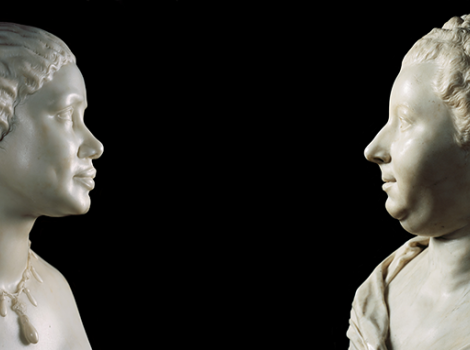
Saki Yokoyama Tsuiki spent two years researching at the National Portrait Gallery. From March 2004 to March 2006 she explored the museum’s operations—education, curatorial, and marketing. Because NPG was in the final phases of its six- year renovation, she was a witness to the process of gallery reinstallation.
What follows is a summary of her observations, accompanied by an interview she conducted with the NPG’s Warren Perry in October 2008. Saki Yokoyama Tsuiki is the curator of education at the National Museum of Western Art, Tokyo, Japan.
Throughout my two-year stay as a fellow at the National Portrait Gallery, I came to think that the notion and existence of a “portrait gallery”—regardless of where it is—is embedded in Anglo culture. One finds portrait galleries in London, Edinburgh, Dublin, Washington, Wellington, and Canberra. The Pantheon in Paris is a similar institution and could easily be added to the list; although, while portrait galleries contain images of representation (paintings, sculptures, prints), the Pantheon is instead a crypt.
Portraiture in Anglo culture and notion of a portrait gallery can be traced back to the British art-historical tradition of such eminent portrait painters as Anthony Van Dyke and Joshua Reynolds. But looking from a different cultural context, it is unlikely Japan would ever have such an institution.
One of my assumptions is that the need—or the lack of need—for a portrait gallery might be attributed to different styles of presenting or representing notable and powerful people in different cultures. For instance, until the nineteenth century, when Japan entered a period of modernization, the emperor did not show himself to the public very often. Some emperors left their portraits, but not all are represented visually, as are the American presidents in the Portrait Gallery’s collection. Also, Japanese nobles scarcely held the custom of commissioning their portraits at important life events, such as marriage, as did Western kings, queens and nobles. This open versus hidden way in which individuals represent themselves presents a clear contrast between Western and Japanese culture.
Listen to an interview with Saki Yokoyama Tsuiki (8:24)


It is true that Japan seems not to do much with portraits. For instance their craftsmen are remembered by the amazing quality of the objects they leave behind.
It also has to do with being humble. In general, Japanese people don't like to post their picture for others to see. However, that is changing with more and more influence from the western culture.
Posted by: japanese words | March 06, 2009 at 03:29 AM
Very interesting point! Thanks Ms.Yokoyama for sharing your story.
Posted by: Cute Easy Hairstyles | March 16, 2009 at 06:00 AM
This is fascinating. Something I never thought about or realized before.
You mention "different styles of presenting or representing notable and powerful people in different cultures," which makes me wonder what style they do use in Japan. If you have any resources for me to see Japanese examples, I'd greatly appreciate it. Thanks.
Posted by: Nursery Decoration | March 24, 2009 at 06:24 PM
I was just "surfing" and stumbled at your post. My son is going to Japan to live for a while next year( we love to travel and know different cultures. We lived in 3 different countries in 3 different continents !)and I already send him the link to your site. You said "the need—or the lack of need—for a portrait gallery might be attributed to different styles of presenting or representing notable and powerful people in different cultures". I didn't know that, but I think you are right. In the Anglo culture the kings and lords preserve their image for the next generations using the portrait...it was just a question of pride. The nobles in the Japanese culture has another approach in his relationship with the power and their vassals. Thanks for posting.
Morganne
Posted by: Morganne | May 03, 2009 at 05:00 AM
Is it not also true that portraits are an expression of the cult of the individual which is such a feature of Western culture?
As this culture is spreading across the world quite rapidly it would be interesting to see if portraiture starts cropping up also in previously non-Western cultures.
Posted by: Bo Baby | November 03, 2009 at 03:28 PM